ISTE Standards & NGSS Science & Engineering Practies

Showing posts with label soft circuit. Show all posts

Tuesday, January 13, 2015

Girls Make IT: Circuits, Coding, and eTextiles (Model 2)

An upcoming event for middle school girls, Girls Make IT:  Circuits, Coding, and eTextiles, has prompted me to design several simple book structures.

I shared one in a previous post and am sharing another one here.  It is my hope that these projects might be easily created in a classroom setting, to help get students and teachers making, while practicing literacy, creativity, and simple circuits.


The following tools and supplies will be useful:

SUPPLIES:
paper for the book block
felt for the cover
1 X 3V coin cell battery
1 X sewable battery holder
conductive thread
embroidery thread
1 X LilyPad LED or 1 X 5mm LED
craft tape
glue

TOOLS:
ruler
glue gun
needle
needle threader
scissors
rotary cutter with a protective mat

Before getting started, you will need to assemble a book block.  I've made mine small enough to fit inside of a 3" X 3"  origami box, but you can make yours any size you like.

(Felt Cover Page 1)
(Felt Cover Page 2)


(Felt Cover Page 3)

Saturday, August 23, 2014

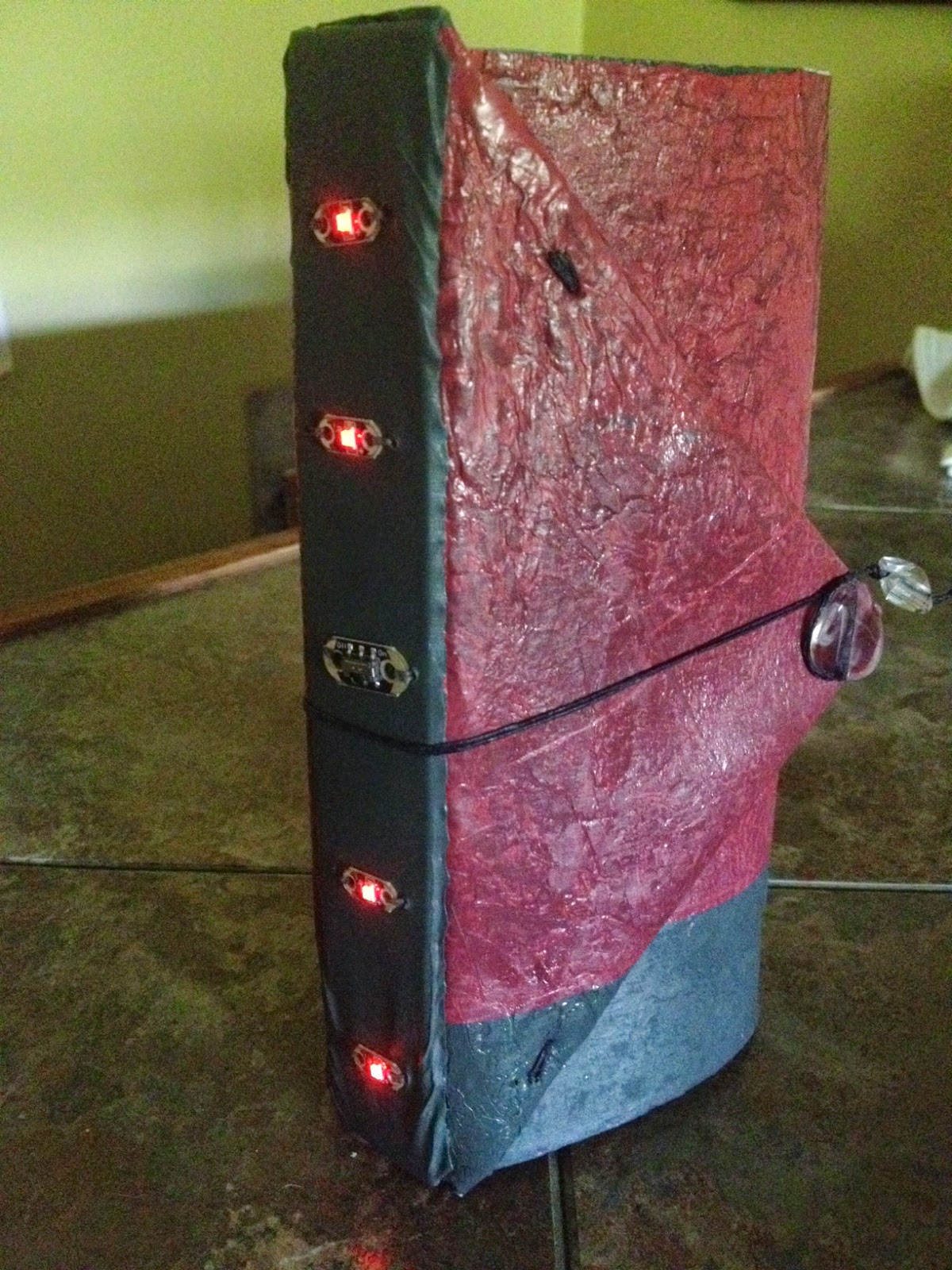
Light-up Wrap Book with a Switch and a Recycled Plastic Bag Cover

I created this model as an experiment to see if I could create a book cover from recycled plastic bags and cardboard.  I wanted to see whether a cover made from recycled materials might be a practical alternative to watercolor paper, for use in a classroom setting.

Ultimately, I was looking for an affordable way for teachers to construct something similar to this with their students.

I've determined that while I personally prefer the look, feel (and smell) of paper covers, using plastic bags  is a viable option.  The covers are durable, and students could easily use an awl (rather than a drill) to poke holes in the spine to sew on their LEDs.

The biggest concern that I have for using this particular structure as an artists' journal would be that the spine can only accommodate the addition of two signatures.  With my current design, the signatures are being sewn onto the loops of conductive thread that are created on the inside cover when the LEDs were sewn to the outside of the covers.  Over time, I worry that the conductive thread will start to fray, leading to malfunctions in the LEDs.  This structure would be much more durable if there were some other loops to hook the signatures on to.

If I do this again, I will change the dimensions of the overall book to be a 4" X 4" square.  I will also add ornamental loops to the spine that will serve as supports for extra signatures and use a lighter-weight paper for the signatures.  I might also try to sew designs or a pocket flap onto the plastic using a sewing machine, before binding the book.

Here is a basic explanation of how I created this plastic book cover.


Wednesday, August 13, 2014

Twinkle Book With Ribbon Closure


I made this journal for a friend using LilyPad LEDs, a Tiny Sparker, and watercolor paper decorated with liquid acrylic ink. 

(Inside)
Watch it Twinkle Here:

The book measures 5" X 7".  The covers are made from binder's board.  The book block was sewn together with linen thread.

I cut a section out of the book block in order to accommodate the battery.  I had to cover up the beautiful blue paste paper on the inside covers, because I deconstructed the book in order to add electronic components after having already assembled it. 

While making this was a good experiment, I don't love the exposed electronic components.


NGSS Framework Practices Addressed

1.  Asking questions (for science) and defining problems (for engineering)
2.  Developing and using models
3.  Planning and carrying out investigations
6.  Constructing explanations (for science) and designing solutions (for engineering)
8.  Obtaining, evaluating, and communicating information


Tuesday, August 12, 2014

Short Wooden Book with Illuminated Spine

Short Wooden Book with Illuminated Spine

Once again, I was compelled to create a book using heart-shaped pieces of papercloth.  Hearts are not typically my go-to shape, but I suppose I just need to go with it.  (R.I.P. Robin Williams)

This is another 5" X 5" book, bound with the "Secret Belgian Binding." It has plywood covers and is sewn together on waxed linen thread.

While making the spine, I replicated the process that I used in an earlier blog post.  This time, I decided to add LEDs and a switch to it.

                                                       (View my Magisto video below.)


In this model, I figured out that Velcro is a great way to keep a battery flap from popping open.  I used a paper battery holder and a 3V battery for this project.

I would prefer this book if the covers were also illuminated.


NGSS Framework Practices Addressed

1.  Asking questions (for science) and defining problems (for engineering)
2.  Developing and using models
3.  Planning and carrying out investigations
6.  Constructing explanations (for science) and designing solutions (for engineering)
8.  Obtaining, evaluating, and communicating information

Monday, August 11, 2014

Book with Watercolor Cover and a Switch

Like the watercolor book that I wrote about in a previous post, this one is equipped with LilyPad LEDs.

The big improvement is in its design, with the addition of a slide switch on the spine.

Here's an Instructable I made if you want to try making one.


Here is a brief video showcasing the book:


NGSS Framework Practices Addressed

1.  Asking questions (for science) and defining problems (for engineering)
2.  Developing and using models
3.  Planning and carrying out investigations
4.  Analyzing and interpreting data
5.  Using mathematics and computational thinking
6.  Constructing explanations (for science) and designing solutions (for engineering)
7.  Engaging in argument from evidence
8.  Obtaining, evaluating, and communicating information

Friday, July 25, 2014

My First Blinged-Out Book!


Over the course of two days, I have completed my first book hack.

I started out by drilling holes into wooden covers, which I attached to a spine using a binding method called the "Secret Belgian Binding."

After piecing the cover together, I drilled holes in the cover for five LEDs.

Audio recording software >>


I inserted the diode through the largest hole before sewing four Lilypad LEDs using conductive thread. I connected all of lights to copper tapes on a paper battery holder that I made.

I have since determined that my 3V battery is not sufficient to power all of the LEDs.  Using the 3V battery, the blue light (the last one in the series) is not getting enough power.I tested this theory by temporarily connecting the cover to a 9V battery.  This made a huge difference, so now I need to find a stronger battery.

I am not too excited about having to take everything apart to create a bigger paper holder, however!

Update:  I just learned that you can STACK coin batteries to increase their voltage!


After playing with the lights, I cut and sewed in the signatures to make a book block.


Lastly, I glued in decorative end papers next (with a flap to reveal the battery).


Here is a peak at the inside.

This book feels nice in the palms of my hands.  Its dimensions are 5" X 5".  I've used Hammermill coverstock for the book block and end papers.


I wish that I'd make the book block a little bit thinner, because there isn't much room for expansion in this model.


Update:  

I have revised this book.  To see how, please visit "Revised Model."


NGSS Framework Practices Addressed

1.  Asking questions (for science) and defining problems (for engineering)
2.  Developing and using models
3.  Planning and carrying out investigations
4.  Analyzing and interpreting data
6.  Constructing explanations (for science) and designing solutions (for engineering)
8.  Obtaining, evaluating, and communicating information