ISTE Standards & NGSS Science & Engineering Practies

Showing posts with label revised. Show all posts

Thursday, September 4, 2014

Zentangle Journals


These are my latest creations.  While I have not demonstrated any new breakthroughs with my understanding of electronics with these particular models, I did make several improvements over the original versions.

Like the previous models, I used conductive thread to sew the LEDs to the spine, and I connected the threads to a battery held in a paper holder.


Unlike the previous models, I did not connect my signatures to the conductive loops of thread that were formed when attaching the LEDs.

Instead, I added a strip of Tyvek over the conductive loops on the inside of the spine and then re-entered the holes attaching the LEDs using a thin linen thread.  I then sewed the signatures to the linen thread loops.  Over time, I suspect that this will result in a more durable book.

Something else that I did differently was decorate my covers with Zentangle illustrations and acrylic inks.  I also improved the structure by sewing a third signature into each model.


Saturday, August 23, 2014

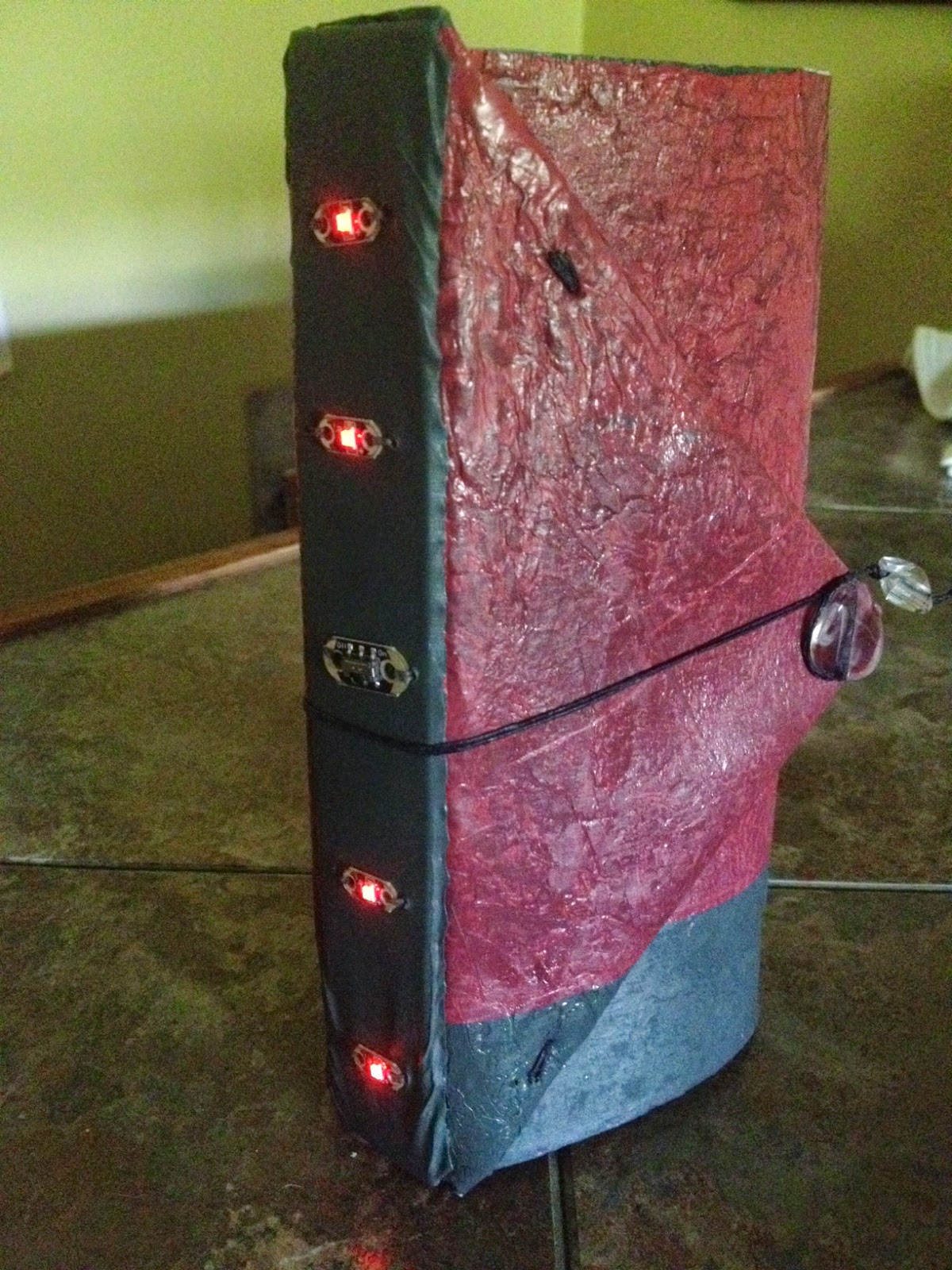
Light-up Wrap Book with a Switch and a Recycled Plastic Bag Cover

I created this model as an experiment to see if I could create a book cover from recycled plastic bags and cardboard.  I wanted to see whether a cover made from recycled materials might be a practical alternative to watercolor paper, for use in a classroom setting.

Ultimately, I was looking for an affordable way for teachers to construct something similar to this with their students.

I've determined that while I personally prefer the look, feel (and smell) of paper covers, using plastic bags  is a viable option.  The covers are durable, and students could easily use an awl (rather than a drill) to poke holes in the spine to sew on their LEDs.

The biggest concern that I have for using this particular structure as an artists' journal would be that the spine can only accommodate the addition of two signatures.  With my current design, the signatures are being sewn onto the loops of conductive thread that are created on the inside cover when the LEDs were sewn to the outside of the covers.  Over time, I worry that the conductive thread will start to fray, leading to malfunctions in the LEDs.  This structure would be much more durable if there were some other loops to hook the signatures on to.

If I do this again, I will change the dimensions of the overall book to be a 4" X 4" square.  I will also add ornamental loops to the spine that will serve as supports for extra signatures and use a lighter-weight paper for the signatures.  I might also try to sew designs or a pocket flap onto the plastic using a sewing machine, before binding the book.

Here is a basic explanation of how I created this plastic book cover.


Sunday, August 17, 2014

Revised Model


In an earlier post, My First Blinged-Out Book, I was thrilled that I had a solid working model, even though I suspected that I might have a power supply problem that needed fixing.  
Today, I revised the cover to add a switch and a LilyPad Tiny Twinkler.  I am most proud of the fact that I was able to get five LEDs to twinkle this time!


(See it in action in the video below).

I lined the front cover with a couple of layers of felt to accommodate the bulk of the battery.


NGSS Framework Practices Addressed

1.  Asking questions (for science) and defining problems (for engineering)
2.  Developing and using models
3.  Planning and carrying out investigations
4.  Analyzing and interpreting data
5.  Using mathematics and computational thinking
6.  Constructing explanations (for science) and designing solutions (for engineering)
8.  Obtaining, evaluating, and communicating information