ISTE Standards & NGSS Science & Engineering Practies

Sunday, December 20, 2015

Blinking Alien Spaceship Book Using Neopixels & an ATtiny85


Solder the neopixels before removing the adhesive from the copper tape.
In the process of prototyping, to see if I could get individually addressable neopixels (surface mounted RGB LEDs) to work in a paper circuit, I've learned a couple of tricks.
The most important one is to solder the LEDs to the copper tape before creating the rest of the circuit. Compared to my first botched attempt, in which I tried to solder neopixels to copper that was already adhered to paper, soldering the LEDs to the copper first was far less fiddly.
Although I had to use a multimeter to isolate a wonky joint (the result to too many cross-overs) I was eventually able to get three LEDs to work the way I'd intended.  Each light changes colors!

In this project, I've added a LilyPad button board in addition to a LilyPad slide switch.


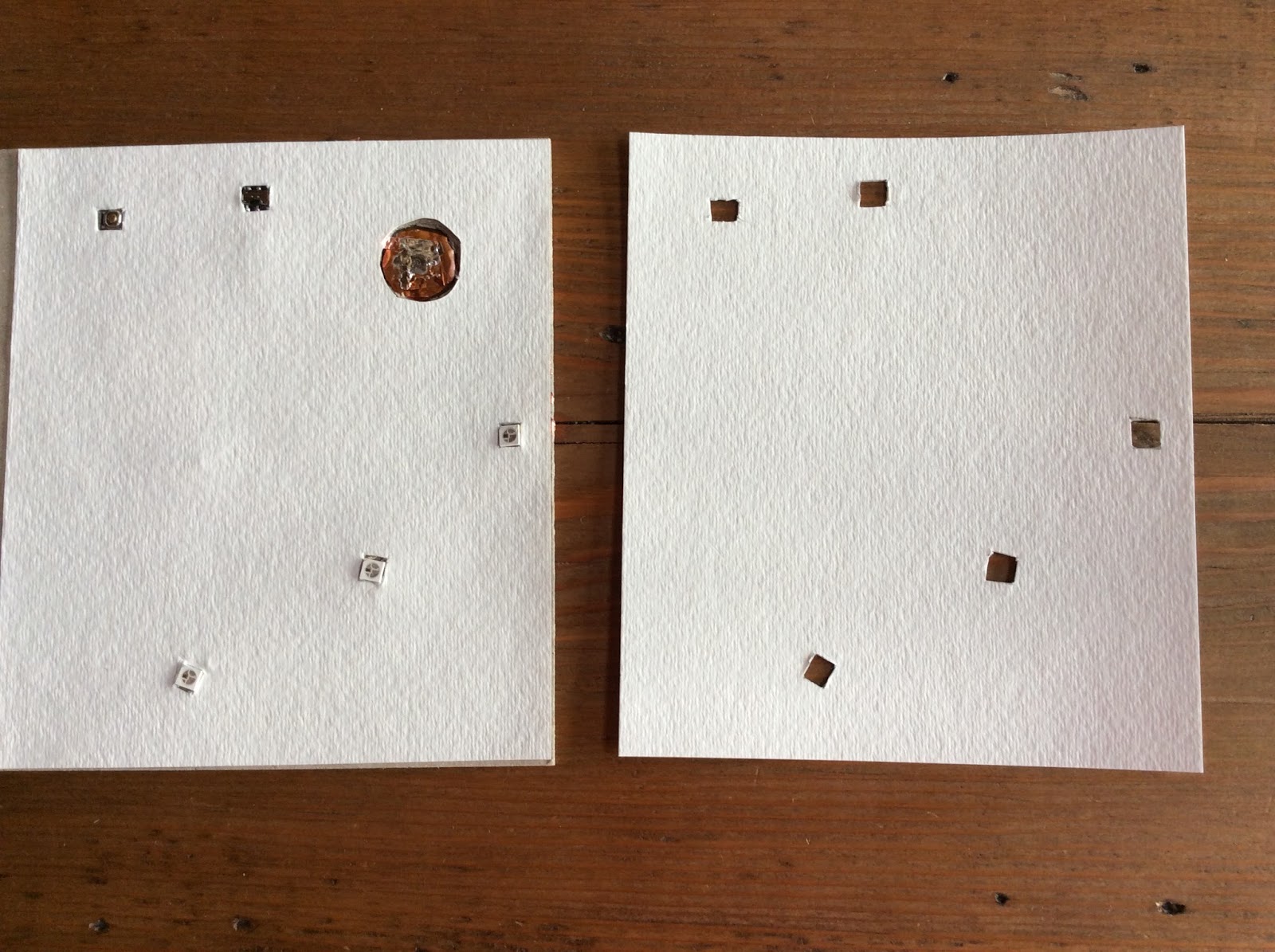
Something else that I've done differently is add two layers of watercolor paper to the binder's board, with notches cut out for the LEDs, button, and switch.  Neopixels are thicker than other SMD LEDs, so the extra paper helps smooth out the surface of the book covers.  I added one layer of watercolor paper to the inside covers as well, hoping to increase the surface tension on the battery. 

Rough sketch
I painted the design and sealed it with acrylic gel medium.


Saturday, December 19, 2015

Alien Paper Circuit with Neopixels & an ATtiny85

Chainable, surface mounted RGB LEDs work in paper circuits! 

After spending a couple of days prototyping, I've completed my first paper circuit using individually addressable neopixels, otherwise known as surface mounted RGB LEDs! Soldering them was trickier than I'd anticipated, however!  I'd originally planned to use three lights in this model, but a soldering mishap resulted in my using only two.  I love the way that the lights change colors at the press of a button!  (See video below).


Thursday, December 3, 2015

Video: Programming an ATtiny85 Microprocessor with a Chromebook

Updated 30 October 2016:  Codebender is closing.  

Programming an ATtiny85 with a Chromebook

I recently completed a video tutorial to teach others how I program the ATtiny85 using a Chromebook.
I'm cross-posting it to this blog as a resource for budding notebook hackers.


Tuesday, November 10, 2015

ATtiny85 Resources

TinyAVR Programmer and Arduino Uno with ATtiny85
I originally started writing about my experiences programming the ATtiny85 on another blog, but it has been brought to my attention that some of you may have been looking for that documentation here.

As a result, I'm cross-posting to help those interested find the information they are seeking, particularly those of you I may have chatted with during Lucie's Making with Code:  Let's Get Physical workshop at Vermont Fest on 6 November.

I've also been asked where to purchase the chips, as well as the method that I prefer when programming the ATtiny85. While I use a TinyAVR programmer for programming circuit sticker microprocessors, I prefer using an Arduino Uno with my ATtiny85's for the following reasons.

1)  It's easier to remove the chip without accidentally bending the legs.

2)  You can set up a breadboard with LEDs to immediately test the code on your ATtiny85.

3)  A lot of people have Arduino boards kicking around (but don't know what to use them for).

Some time early next year I hope to teach another workshop or two geared towards educators and students, as a large number of you expressed disappointment that you were unable to attend the Notebook Hacking session at Vermont Fest.

Tuesday, November 3, 2015

How to Solder Surface Mounted LEDs in Paper Circuits

Soldering has brought me so much unexpected happiness, that it's hard for me to believe that I didn't learn how to do it until two summers ago. Better late than never! Thank you, +Craig Lyndes, for teaching me how to solder!

Since a lot of people have asked me how I solder surface mounted LEDs in my projects, I decided to create this video for a class I'm taking.

If you haven't yet tried your hand at soldering, I hope this will motivate you to grab a soldering iron, crack a window and a smile, and have fun!  (You may need to change the video settings to HD 720 once it starts.)


Thursday, October 22, 2015

Notebook Hacking Podcast

I created this podcast for a class that I'm taking but decided to share it here for those interested in learning more about Notebook Hacking.


AG Planning a Notebook Hacking Activity for 7th Graders

Monday, September 14, 2015

Maple Leaf Book

Maple Leaf Book

Brainstorming


Paper Circuit Embedded into Book Cover
After experimenting with some Arduino sample code, I ended up creating a circuit that resembles a leaf when it's in action.

I'd originally set out to create something a bit more abstract, but a maple leaf emerged from the mess of solder and copper tape.


For the cover boards, I painted 2-ply Bristol with Jacquard Lumiere paints.


Keith A. Smith's "Broken H's" binding

Magnetic Flap to Hide Battery